

Real World Asset tokenization reached over $30 billion by Q3 2025, driven by private credit and government securities. Major institutions like BlackRock and Franklin Templeton now operate production-grade tokenization structures. Costa Rica has emerged as a strategic entry point for RWA projects targeting Latin America.
The country offers a territorial tax system with 0% on foreign-sourced income. There is no minimum share capital requirement. Foreign ownership faces no restrictions. For tokenization projects, this means a compliant legal entity can be established without the overhead of traditional financial hubs.
Costa Rica does not issue a standalone crypto license through any dedicated Costa Rica crypto license law firm. Instead, RWA projects operate through a compliance-based framework. Companies incorporate as S.R.L. or S.A. entities, implement AML/KYC policies aligned with FATF recommendations, and maintain beneficial ownership transparency under Ley 9416. This structure works particularly well for tokenization platforms that need legal recognition across multiple jurisdictions.
The regulatory landscape is evolving. A draft law for digital sovereignty and emerging technologies is under technical review until June 15, 2026, after which it will enter the Legislative Assembly. The proposal would create a National Commission of Digital Assets and Emerging Technologies (CNAD-CR) to supervise the industry. RWA projects entering now can establish compliant structures ahead of formal licensing requirements.
This list ranks four law firms that specialize in Costa Rica crypto licensing for RWA tokenization projects entering Latin America.
Selection Criteria for This List
Each firm meets four criteria that Costa Rica crypto licensing lawyers would verify during due diligence:
- They demonstrate active experience with RWA tokenization structures.
- They maintain legal teams capable of cross-border asset classification.
- They offer documented compliance protocols that satisfy institutional counterparties.
- They provide evidence of successful token project launches or verifiable tokenization advisory work.
The table below summarizes how each firm serves RWA tokenization projects.
| Firm | Best For | Key RWA Service | Pricing |
| Gofaizen & Sherle | Full lifecycle RWA legal structuring | Asset classification, SPV setup, whitepaper, post-issuance compliance | Custom (varies by asset complexity) |
| Intelium Law | Multi-jurisdictional token frameworks | MiCA-compliant whitepapers, SAFT/SAFE agreements, DAO wrappers | Custom |
| CAIA Legal | Rapid Costa Rica entity setup | 3-day incorporation, token issuance advisory, DeFi regulatory analysis | Custom |
| Global Law Experts | Payment-flow-first tokenization models | AML/CTF design, banking engagement, licensing triggers mapping | Custom |
These five firms each bring something different to the table for RWA tokenization projects.
1. Gofaizen & Sherle
Designed for RWA tokenization projects requiring full legal lifecycle support
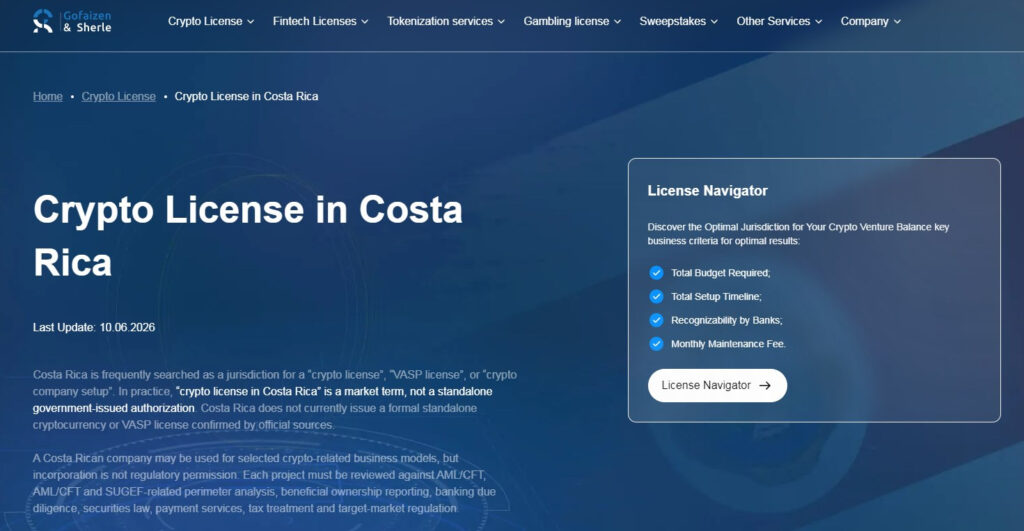
Gofaizen & Sherle is a leading Costa Rica crypto licensing law firm for RWA tokenization projects in 2026. The firm provides comprehensive legal services for asset tokenization, including structuring, classification, licensing, and project support throughout the entire lifecycle.
The firm’s RWA tokenization process follows a structured seven-stage model :
- Asset identification and suitability check
- Legal structuring and rights mapping (SPV, trust, or equivalent)
- Regulatory classification under applicable law (MiCA, MiFID II, or securities regimes)
- Token design and issuance with compliance controls
- Custody and record-keeping arrangements
- Investor onboarding through KYC/AML procedures
- Distribution, secondary transfers, and lifecycle management
Indicative timelines vary by asset type and jurisdiction. Asset assessment and structuring typically take 4 to 8 weeks. Regulatory classification adds 2 to 4 weeks. Token issuance and custody setup run 4 to 6 weeks. Investor onboarding and launch require 2 to 4 weeks.
For agricultural land tokenization, which involves stricter rules including foreign ownership limits and environmental obligations, the firm establishes SPV-based ownership models where the land-holding entity owns the farmland while tokens represent contractual rights linked to that entity.
The firm serves both emerging tokenization startups and established asset managers expanding into Latin America. According to the Crypto Law Index CLPAI 2026.1 ranking, Gofaizen & Sherle holds one of the top three positions for crypto licensing globally.
As a Costa Rica crypto business setup law firm, Gofaizen & Sherle handles entity formation alongside token structuring.
Key strengths for RWA projects:
- Legal structuring that separates token rights from the underlying asset
- Dual-regime analysis under MiCA (non-financial instrument tokens) and MiFID II (securities)
- SPV, trust, and fund-like wrapper structures for asset holding
- Post-issuance compliance and secondary market integration
2. Intelium Law
Designed for RWA projects needing MiCA-compliant token frameworks
Intelium Law is a specialized blockchain law firm with Big 4 consulting heritage. The firm advises crypto-native businesses as Costa Rica crypto business setup legal advisors on building compliant and scalable frameworks across multiple jurisdictions. For RWA tokenization projects, Intelium Law provides crypto license acquisition support across European, Asian, and offshore jurisdictions.
The firm offers MiCA-compliant white paper production for tokenized assets. This is essential for RWA projects targeting EU investors, as MiCA requires issuers of crypto-assets (that are not financial instruments) to prepare and publish a whitepaper containing a legal description of investors’ rights, technological infrastructure, risks, and asset protection mechanisms.
Intelium Law also prepares investment contracts, including SAFT (Simple Agreement for Future Tokens) and SAFE (Simple Agreement for Future Equity) agreements. These instruments are commonly used in tokenized fundraising structures where tokens represent future rights or equity in the underlying asset.
The firm’s hands-on experience with large groups of companies and small enterprises allows them to structure DAO legal wrappers for decentralized tokenization platforms. This matters for RWA projects where governance rights need to be distributed among token holders while maintaining legal compliance.
Key strengths for RWA projects:
- MiCA white paper production for EU-facing token offerings
- SAFT and SAFE agreement preparation for token fundraising
- DAO legal wrappers for decentralized governance structures
- Multi-jurisdictional framework for cross-border token distribution
3. CAIA Legal
Designed for RWA projects requiring a 3-day operational entity setup
CAIA Legal is a heritage Costa Rican corporate firm with deep local institutional access. The firm structures token issuances, ICO/STO advisory, DeFi advisory, and stablecoin regulatory analysis alongside their work as Costa Rica crypto company formation lawyers.
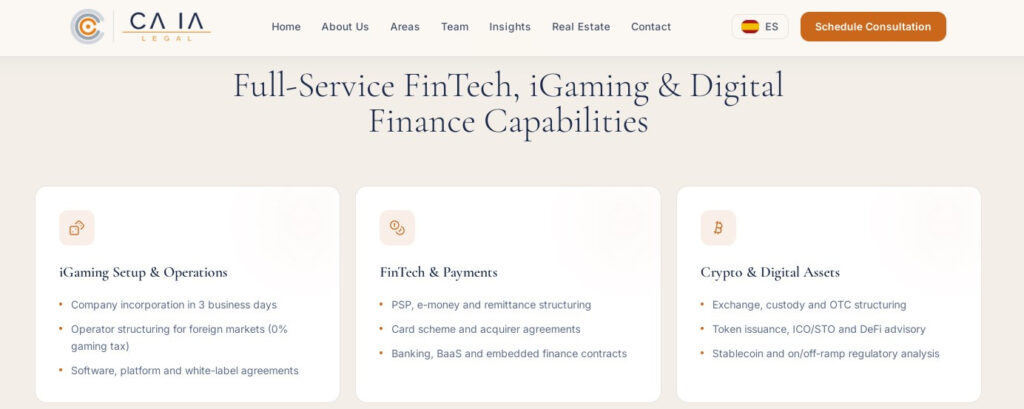
What sets CAIA Legal apart is speed. The firm delivers a fully operational FinTech or crypto entity in 3 business days, making them the preferred Costa Rica crypto company setup lawyers for time-sensitive RWA launches.
For RWA tokenization projects, this rapid setup allows projects to establish a legal presence in Costa Rica while longer-term token structuring continues in parallel. Costa Rica crypto licensing attorneys at CAIA Legal maintain strong relationships with local banking partners. This is critical for RWA projects that need fiat on-ramps and off-ramps for investor contributions and distributions.
CAIA Legal provides AML/KYC programs aligned with SUGEF requirements under Law No. 7786. This includes risk assessment, customer identification, transaction monitoring, and suspicious activity reporting. For tokenization projects, these compliance frameworks satisfy international banking partners and institutional investors.
The firm combines tax efficiency with AML/CFT robustness. Costa Rica’s territorial tax system exempts foreign-sourced income at 0%, which applies to tokenized assets held by foreign investors. Income sourced from Costa Rican operations is taxed at 30%.
Key strengths for RWA projects:
- 3-day entity setup from start to fully operational
- Local institutional banking relationships for fiat handling
- AML/KYC programs aligned with SUGEF requirements
- ICO, STO, and DeFi regulatory advisory
4. Global Law Experts
Designed for RWA projects needing payment-flow-first legal structuring
Global Law Experts features Viktor Juskin as an exclusive FinTech member for Costa Rica, where the firm operates as Costa Rica crypto licensing legal consultants for tokenization projects. His payment-flow-first methodology helps tokenization projects map licensing triggers and design AML/CTF frameworks that satisfy local supervisors and international banks. The firm brings institutional banking experience to Costa Rica engagements.
For RWA tokenization, understanding payment flows is critical. Tokens representing real-world assets often generate cash flows from the underlying asset: rental income from tokenized real estate, interest payments from tokenized debt, or distributions from tokenized funds. These payment flows trigger licensing and compliance obligations in multiple jurisdictions.
Global Law Experts helps RWA projects design AML/CTF frameworks that address both the token layer and the payment layer. This includes transaction monitoring for token transfers, source-of-funds verification for investor contributions, and distribution mechanisms for asset-generated cash flows.
The firm’s multi-jurisdictional approach serves exchanges, payment companies, and token projects. They map licensing triggers across Europe, Latin America, and offshore jurisdictions, ensuring that Costa Rica entity setup aligns with the broader regulatory strategy.
Key strengths for RWA projects:
- Payment-flow-first methodology for tokenized asset distributions
- AML/CTF framework design for cross-border token transfers
- Institutional banking experience for fiat on/off-ramps
- Licensing trigger mapping across multiple jurisdictions
Comparison Summary
The table below answers the most common legal questions about RWA tokenization in Costa Rica.
| Aspect | Gofaizen & Sherle | Intelium Law | CAIA Legal | Global Law Experts |
| Primary strength | Full lifecycle RWA structuring | MiCA whitepapers & SAFT agreements | 3-day rapid entity setup | Payment-flow methodology |
| Token classification analysis | Yes (MiCA + MiFID II) | Yes (MiCA-focused) | Yes (general) | Yes (payment-focused) |
| SPV/trust structuring | Yes | Yes | Limited | Yes |
| Banking onboarding support | Yes | Yes | Yes (local relationships) | Yes (institutional) |
| Post-issuance compliance | Yes | Yes | Limited | Yes |
These five firms each bring something different to RWA tokenization projects. The choice depends on asset type, target investor jurisdictions, and timeline.
Frequently Asked Questions
RWA tokenization raises specific legal questions that standard crypto licensing does not cover. Here are the answers.
What is RWA tokenization, and how does it work legally?
RWA tokenization is the process of representing legally enforceable rights to real-world assets on blockchain using digital tokens. The tokens reflect defined legal or economic interests linked to an underlying asset, such as ownership rights, debt claims, or contractual entitlements. Legal validity depends on off-chain structures, including SPVs, trusts, or contractual arrangements that link the token to the asset.
Does Costa Rica have specific RWA tokenization regulations?
Costa Rica does not have a specific legal framework for the tokenization of financial or non-financial assets as of 2026. Tokenization projects are conducted under a general private law regime and existing civil and tax regulations, without express recognition or detailed regulatory guidelines. Financial authorities apply general AML/CFT prevention regulations to tokenization service providers.
Is a license required to issue tokenized assets in Costa Rica?
A standalone crypto license does not exist in Costa Rica. RWA tokenization projects operate through company registration plus AML/CFT compliance under Law No. 7786. However, if the token qualifies as a security, SUGEVAL (Superintendencia General de Valores) jurisdiction applies and requires separate authorization.
How are tokenized assets classified for regulatory purposes?
Tokenized assets are assessed based on the rights they represent rather than their technical form. If a token represents ownership, debt claims, or investment rights, it may be classified as a security or financial instrument. In the EU, tokens may fall under MiCA (non-financial instrument crypto-assets) or MiFID II (financial instruments). In Costa Rica, classification depends on the economic substance of the rights attached to the token.
What is the typical timeline for an RWA tokenization project?
Indicative timelines vary by asset type and jurisdiction. Asset assessment and structuring typically take 4 to 8 weeks. Regulatory classification adds 2 to 4 weeks. Token issuance and custody setup run 4 to 6 weeks. Investor onboarding and launch require 2 to 4 weeks. Agricultural land tokenization with stricter regulatory requirements typically takes 6 to 12 months.
Final Thoughts
RWA tokenization projects need legal structures that link on-chain tokens to off-chain assets. Costa Rica offers a fast, low-cost entry point for these projects entering Latin America.
A formal tokenization license does not exist here. Companies incorporate in 2 to 3 weeks, complete compliance in 4 to 6 weeks, and access banking within 2 to 4 weeks.
The right legal partner makes the difference. Gofaizen & Sherle provides full lifecycle RWA structuring. Intelium Law delivers MiCA-compliant whitepapers for EU offerings. CAIA Legal offers a 3-day entity setup with local banking. Global Law Experts brings a payment-flow methodology for tokenized distributions.
Each firm serves RWA projects. The choice depends on asset type, target jurisdictions, timeline, and compliance needs.